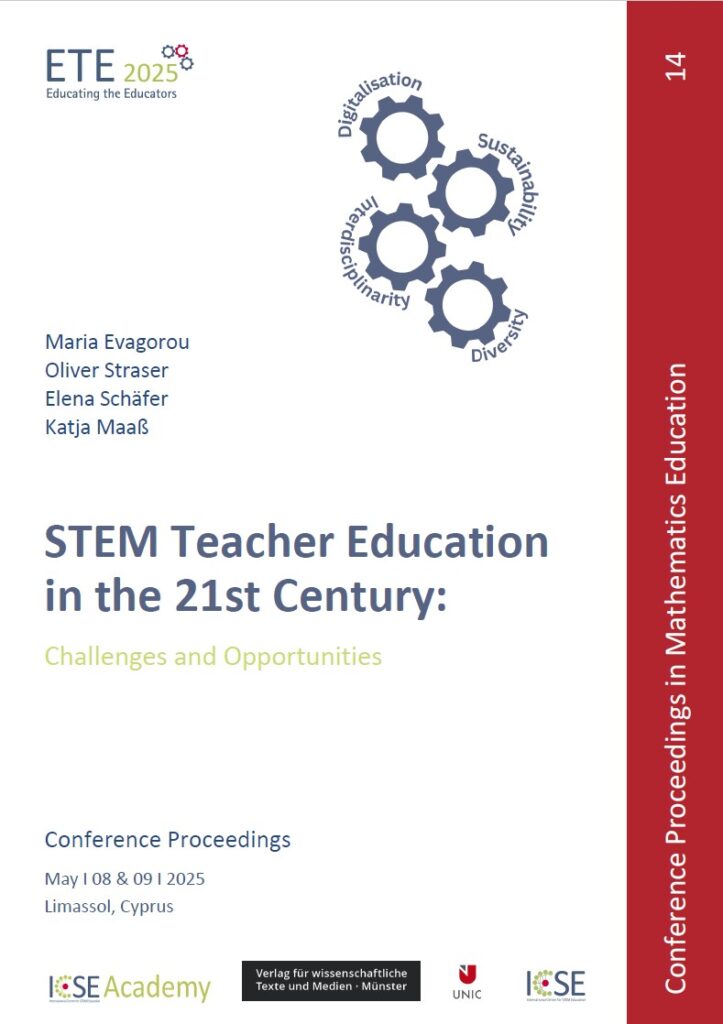

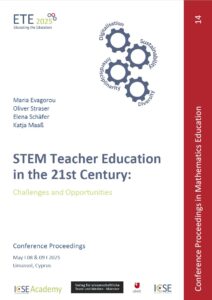
 Proceedings of the 5th Educating the Educators Conference
Band 14 der Reihe Conference Proceedings in Mathematics Education
Münster 2026, ca. 200 S.
978-3-95987-343-7 Print 32,90 €
978-3-95987-398-7 E-Book Open Access
Sie können das gedruckte Buch –>HIER kaufen
Sie können das Buch –>HIER herunterladen
https://doi.org/10.37626/GA9783959873987.0
Abstract of Book
Our society faces enormous challenges that require innovative and sustainable solutions. Among the most pressing issues for education today are diversity in STEM education, digitalisation, interdisciplinarity, and sustainability. Adressing these issues in STEM education, helps preparing young people to become active, responsible citizens. Teachers are central to this transformation, and their professional development is crucial for fostering competences that matter in the 21st century.
Educating the Educators (ETE) is an international conference series on professional development in STEM education that brings together teacher educators, policy makers, teachers and other stakeholders. The fifth edition, ETE V, marked the celebratory finale of the ICSE Academy project and focused on teacher mobility as a driver for innovation in STEM education. Participants explored how mobility experiences can strengthen inclusion, sustainability and digitalisation in teaching and learning, and how systemic structures can support these efforts.
ETE V provided a vibrant space for exchange, collaboration and cocreation, highlighting the importance of shared practices and policies for scaling up innovative approaches in STEM teacher education. This volume reflects the main themes and discussions of the conference and the collective vision for future collaboration.
Contributions with indiviual DOI
Elena Meister, Oliver Straser, Jennifer Stemmann, Katja Scharenberg, Silke Mikelskis-Seifert, Nadine Tramowsky and Wolfram Rollett: Testing Digital On-Demand Support and Multimedia for Developing Experimentation Competencies
https://doi.org/10.37626/GA9783959873987.0.01
Abstract
A key goal of climate education in schools is students’ development of climate literacy. In this regard, experimentation competency relates to climate literacy. However, due to the inherent complexity of the experimentation process, fostering this competency is challenging. Given the variety of students’ heterogeneous learning prerequisites, digital environments have the potential to support learning through multimedia design and scaffolding. Although theoretical foundations suggest the benefits of both scaffolding and multimodal learning, there is empirical evidence for digital implementations, particularly in individual learning contexts. The present study investigated the effects of digital on-demand instructional support (ODIS) and multimedia instruction on sixth graders‘ experimental performance.
Using a 2 x 2 experimental field study design, 327 German sixth graders from 17 schools were randomly assigned to four conditions: text-based or multimedia instruction, with or without access to ODIS. Students completed hands-on experiments independently, guided by a digital learning environment. The experimentation process was divided into four phases: hypothesis formulation, planning, execution, and interpretation. Performance was assessed through open-ended responses (coded with substantial to excellent inter-rater reliability, ICC = .81-.91), as well as through automated evaluation.
Two-way ANOVAs revealed no significant effects of ODIS (F(1, 323) = 0.27, p = .61) or multimedia instruction (F(1, 323) = 0.00, p = .96) on overall experimental performance. Sensitivity analyses confirmed these null findings. However, a mixed ANOVA revealed significant performance differences across phases (F(3, 969) = 61.20, p < .001, ηG² = .11).
These results suggest that the availability of digital ODIS and multimedia features may be insufficient. Potential explanations include suboptimal interface design, non-use of ODIS, and mismatches between the support offered and student aptitude. Future research should examine actual ODIS usage patterns as well as differential effects and optimize digital learning environments. In terms of didactic implications for designing digital learning environments, simply providing students with ODIS, videos, and audio files is not sufficient to enhance performance.
Erste Seite: 50
Letzte Seite: 56