 Münster 2026, ca. 190 S. DIN A5
erscheint April 2026 – To appear April 2026
Print: ISBN 978-3-95987-367-3, 30,90 €
E-Book: ISBN 978-3-95987-368-0, 27,90 €
Abstract
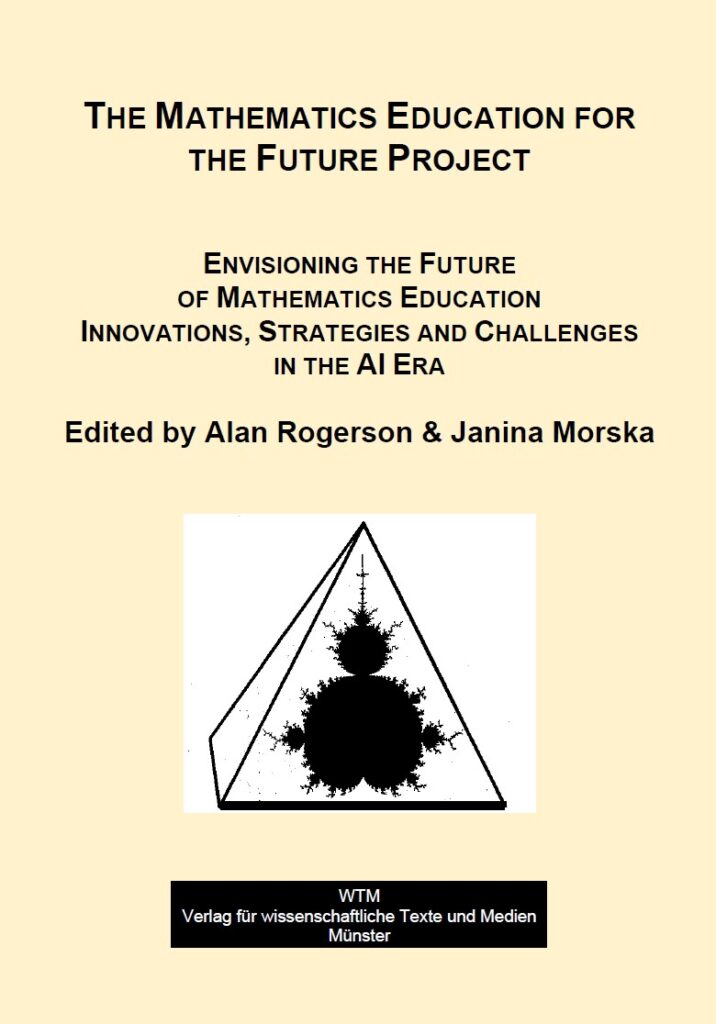
Of the 30 papers in this book 7 of them examine in detail AI applications to see their strengths and weaknesses in the practical classroom teaching of mathematics. Another 15 papers introduce a variety of new and important projects in curriculum content, teacher education, undergraduate maths, classroom teaching in schools and universities and 4 papers discuss important work with the indigenous people of Papua New Guinea, Ghana, India and the Bedouin. Finally, we are very proud to welcome 4 papers from high school students: Freya Amar Shah, Ada Singh and Maedeh & Ala Hassani Nezhad, as part of our DSR initiative.
=====================================================
Stephannie Abbey: Experiences from Professional Transitions of Black Mathematicians from Ghana to the United States
Abstract
Since there is a need for professionals with advanced scientific and computational skills universities and employers search for talent around the world. This study explores the academic and professional experiences of Black Ghanaian mathematicians who studied and worked in the United States. Our findings show that international mobility creates important academic and professional opportunities, but success depends strongly on access to funding, mentorship, supportive networks, and culturally affirming spaces. Participants included faith and community as important sources of strength during difficult transitions, and need for structured academic.
Frist page: 1
Last page: 6
https://doi.org/10.37626/GA9783959873680.0.01
=====================================================
Fouze Abu Qouder & Miriam Amit: Ethnomathematics: Integrating Culture and Mathematics Teaching in Bedouin Education
Abstract
This study examines the integration of ethnomathematics in Bedouin education, focusing on traditional measurement units and geometric patterns in Bedouin embroidery. Grounded in D’Ambrosio’s ethnomathematical framework, it argues that mathematics teaching becomes more meaningful when connected to students’ cultural experiences. Using a mixed-methods design, the research combined ethnographic interviews, culturally based curriculum development, and an experimental implementation. Findings revealed increased motivation, self-esteem, and achievement among students exposed to culturally integrated instruction. The study concludes that embedding cultural knowledge in mathematics enhances learning and strengthens cultural identity, calling for culturally responsive curricula and teacher training. Moreover, it highlights the importance of preserving indigenous knowledge systems and integrating them into formal education.
First page: 7
Last page: 11
https://doi.org/10.37626/GA9783959873680.0.02
=====================================================
David M. Bressoud: Project EMBER: A Network Empowering Teaching-focused Faculty to Employ Evidence-based Reforms
Abstract
Project EMBER (Eliminating Mathematics Barriers through Evidence-based Reforms) is a joint effort of APLU (Association of Public and Land-grant Universities) and TPSE Math (Transforming Post-Secondary Education in Mathematics), working with the public universities in the United States to introduce evidence-based reforms into introductory courses in university mathematics. This will be a report on the ongoing efforts of this project.
First page: 12
Last page: 15
https://doi.org/10.37626/GA9783959873680.0.03
=====================================================
Gail Burrill: Teaching and Learning Mathematics in an AI World
Abstract
Artificial intelligence (AI) is rapidly changing the way we work, create, solve problems, and interact. AI’s ability to analyze vast amounts of data, recognize patterns, synthesize information, and respond to prompts gives it the potential to transform much of what we do in our personal lives and in our work. A big question is what impact can/should AI have on education? This paper briefly describes what AI is, what it can do and cannot do, then focuses on the role of AI in the teaching and learning of mathematics, considering the opportunities and challenges Large Language Models bring to the classroom.
First page: 16
Last page: 21
https://doi.org/10.37626/GA9783959873680.0.04
=====================================================
Richard Catterall: What? Who? How? Using Educational Capital
Abstract
Nowadays many students are hampered in their learning journey by a belief they are constrained by the circumstances around them. This belief means that they justify their perceived shortcomings, overwhelmed by the rightness of their feelings and will not appreciate opposing points of view or the possibility they may be wrong. I aim to shatter those perceptions, helping them dream beyond limits.
First page: 22
Last page: 27
https://doi.org/10.37626/GA9783959873680.0.05
=====================================================
György Emese: Two Projects to Develop Non-traditional, Mainly Real-life Mathematics Problems (DQME and RLTG)
Abstract
The first part of this paper describes an earlier COMENIUS EU math education project, the Developing Quality in Mathematics Education (DQME), which developed, tested, and disseminated non-traditional, mainly real-life mathematics problems. Students often worked independently, in pairs, or in groups, sharing their knowledge (reports, jigsaw method). The second part of this paper describes a similar, in some sense, follow-up project, the Real Life Themes Group (RLTG), organized later by Alan Rogerson, offering 1000+ worksheet pages of the 60+ real-life themes, and making them available worldwide for free for many more teachers and their students to use. I will present some of my favorite problems in the projects, one of my own, and one from my Grade 8 student. Finally, I will write about how teachers can use this rich collection of materials.
First page: 28
Last page: 32
https://doi.org/10.37626/GA9783959873680.0.06
=====================================================
Ben Galluzzo, Thomas Hemker & Kathleen Kavanagh: Exploring an AI Facilitation Approach to Teaching Math Modeling
Abstract
Mathematical modeling offers powerful opportunities for students to connect mathematics with authentic, real-world contexts. Learners often struggle to structure open-ended problems, make assumptions, and evaluate their models, while teachers face parallel challenges in facilitating and guiding this process effectively. This paper introduces an AI-facilitated learning tool designed to support both students and educators in mathematical modeling. The tool assists student modelers while providing teachers with structured resources and strategies for scaffolding tasks. Features include explanations of modeling techniques with examples, formative feedback on drafts, and tools for validation. By combining interactive Q&A, collaboration functions, and adaptive AI support, the tool aims to enhance student learning while empowering teachers with confidence and capacity to teach modeling.
First page: 33
Last page: 38
https://doi.org/10.37626/GA9783959873680.0.07
=====================================================
Anant Godbole & Ryan Nivens: Mathematics Education Ramifications of 35 Years of Undergraduate Research Direction
Abstract
Godbole has advised between 6 and 12 undergraduate students (and up to 3 teachers) each summer since 1991, as they conducted research funded by the National Science Foundation under his direction. Coming from prestigious colleges and universities across the United States, students have published ~80 refereed papers individually or with Godbole. Godbole was recently recognized by the Association of Women in Mathematics, who selected him for the Gweneth Humphreys Award for Mentorship. This paper will overview the achievements of some of these students, including their recent academic appointments. Godbole will share his own career’s symbiotic link to that of his summer students. Nivens will consider his joint work with Godbole and the broader Mathematics Education implications.
First page: 39
Last page: 44
https://doi.org/10.37626/GA9783959873680.0.08
=====================================================
John Gordon: Advancing Mathematics and AI Pedagogy: A Specialized Training Program for Educators of Gifted Learners
Abstract
The rapid evolution of mathematics and AI demands a transformative approach to teacher training for gifted students. AI concepts like machine learning require advanced proficiency, while gifted math education must foster deep understanding and problem-solving. Without specialized strategies, educators may struggle to provide rigorous instruction. This paper examines a four-year training program equipping educators with advanced subject knowledge, pedagogy, and AI applications. It evaluates the curriculum’s impact on instructional efficacy and gifted education. The program integrates Financial Mathematics, Geometry, Set Theory, Probability, and Nutrition for Cognitive Function. These subjects strengthen reasoning, real-world application, and cognitive well-being. The curriculum enhances analytical skills and reinforces the link between well-being and intellectual performance.
First page: 45
Last page: 49
https://doi.org/10.37626/GA9783959873680.0.09
=====================================================
John Gordon, Carolyn King, ChangZe Gao & Jonathan Martinez: Embedding Research Projects into an Introductory ODE Course: Two Exhibits on Pursuit Curves and Crosswind Guidance
Abstract
We report on a research-project-centered pedagogy for an introductory ODE course at an American two-year college. This approach replaces a formuladriven syllabus with guided modeling investigations, weekly studios, and a capstone research paper. Building on pilot results showing improved performance, we present two student exhibits: (A) a classical curve of pursuit and (B) aircraft guidance in a steady crosswind. Each exhibit includes the modeling formulation, ODE derivation, analytic solution, and parameter studies. We conclude with reflections on how these projects cultivate core capacities— problem formulation, dimensional reasoning, and qualitative analysis—and align with an assessment framework for open-ended work in lower-division ODE.
First page: 50
Last page: 54
https://doi.org/10.37626/GA9783959873680.0.10
=====================================================
Ivona Grzegorczyk: Students’ Performance in Mathematics Aided by AI Tools
Abstract
Freshmen college mathematics students were assigned weekly multiple-choice quizzes and higher-level thinking skills problems to be solved at home. We collected individual data from three groups learners with different access to AI tools. We compared students’ performance on these tasks and on the comprehensive paper and pencil testing that was written without any use of electronics. Our results show significant positive change on quizzes and homework scores for all tree groups as well as better performance on the exams for students supported by AI. Additionally, collected participants’ comments on the use of AI tools to learn mathematics.
First page: 55
Last page: 60
https://doi.org/10.37626/GA9783959873680.0.11
=====================================================
Paul Hernandez-Martinez: Telling Stories about Mathematics and its Relevance: The Vision Behind the International Mathstory Competition
Abstract
The Mathstory competition was designed to encourage undergraduate students to communicate mathematics through storytelling. Mathstory asks participants to create short digital stories that convey the meaning and significance of mathematics, as opposed to typical competitions that reward high mathematical ability. The competition sees storytelling as an affective and cognitive activity, drawing on Bruner’s (1991) concept of narrative as a form of meaning-making and Vygotsky’s (1930) view of imagination as essential to creativity. Mathematical storytelling requires deep conceptual understanding and emotional connection, transforming abstract ideas into meaningful and relatable narratives. Mathstory aims to promote positive dispositions towards mathematics, seeking to redefine mathematics as a human/cultural act, opening up different ways of understanding and speaking about mathematical ideas.
First page: 61
Last page: 66
https://doi.org/10.37626/GA9783959873680.0.12
=====================================================
Iris DeLoach Johnson & Lilian Chimuma: Not Fibonacci, but European Rabbits! How Six Generative AIs Tackled a Mathematical Modeling Challenge
Abstract
This paper revisits a population growth scenario originally posed by Alan Rogerson (2021), involving European rabbits that reproduce in 3-4 months with a one-month gestation period. Each adult pair yields five offspring—two female sand three males—creating a mathematically rich modeling context similar, yet distinct, from the classic Fibonacci sequence. The same prompt was presented to six generative AI (GenAI, or hereafter AI) tools (Khanmigo, ChatGPT4.1 and 5.1, Claude.ai Sonnet 4.5, and DeepSeek) to examine how each supported the solution process. The qualitative comparison of AI outputs highlights how AI can both support and challenge mathematical thinking in the classroom. The paper concludes with pedagogical strategies emphasizing the importance of fostering AI literacy and productive inquiry among teachers and students.
First page: 67
Last page: 75
https://doi.org/10.37626/GA9783959873680.0.13
=====================================================
Scott Kissau: Preparing Teachers of Language and Content: Project TLC
Abstract
Project TLC was a grant-funded teacher residency program developed by a college of education in the southeastern United States in partnership with a large urban school district to address critical shortages of STEM educators and teachers of color. The program prepared 24 diverse teacher candidates across two cohorts for dual licensure in a hard-to-staff secondary content area (e.g., math, science, or technology) and English as a Second Language. Of the 24 participants, 63% identified as Black or Hispanic, and 50% specialized in a STEM field. The residency included intensive coursework, a year-long clinical internship with a mentor teacher, a living wage stipend, and ongoing induction support. Two years after the first cohort’s completion, 96% of graduates remained employed as teachers. Key lessons learned include the importance of offering competitive stipends, partnering with multiple districts, reducing service commitment barriers, and providing content-specific mentoring and a supportive cohort model to enhance recruitment and retention.
First page: 76
Last page: 81
https://doi.org/10.37626/GA9783959873680.0.14
=====================================================
Sebastian Kuntze & Jens Krummenauer: Strengthening Students in Dealing with Disinformation Attempts – How can we Prepare Pre-Service Teachers to New Challenges for the Mathematics Classroom?
Abstract
Mathematics as a truth-seeking and argumentation science provides a value background for goals of the mathematics classroom related to strengthening students in dealing with disinformation attempts: Corresponding students’ competences appear as more than ever necessary in the digital age. As concepts for the preparation of pre-service mathematics teachers are needed both on the levels of professional knowledge on task formats and of classroom practices, profession-related learning opportunities are suggested and analysed in this contribution, with a particular focus on principles of scientific reasoning and data-based argumentation in the mathematics classroom. We discuss how classroom cartoon vignettes can be used in teacher education to showcase and reflect on examples of innovative classroom practices and the enactment of socalled evaluation-of-claims argumentation tasks.
First page: 82
Last page: 89
https://doi.org/10.37626/GA9783959873680.0.15
=====================================================
Johannes Memling, Dongwook Kim & Hyemin Yoo: Enhancing Mathematics Education with AI and Containerization
Abstract
Containerization and AI are beginning to transform math education, providing access to advanced tools like SageMath and Jupyter Notebooks via Docker and Kubernetes. These standardized containerized environments eliminate setup issues, ensuring reproducibility and focusing students on concepts such as identifying patterns in elliptic curves. The infrastructure enables portable, cloud-based access to powerful computing, removing dependence on expensive personal hardware. AI personalizes learning with adaptive practice and feedback, preserving the role of the human teacher as a mentor. This synthesis creates a more accessible, consistent, and personalized mathematical learning experience.
First page: 90
Last page: 95
https://doi.org/10.37626/GA9783959873680.0.16
=====================================================
Mrinaalini. P & Agustya Gurukulam: Mathematics with a Practical Approach and Thoughts in Samskritam
Abstract
Open source tools can be used to expand our experience of mathematical applications in real life. The paper tries to illustrate and emphasize teachings in the language of samskritam in relation with mathematical concepts.
First page: 96
Last page: 102
https://doi.org/10.37626/GA9783959873680.0.17
=====================================================
Maedeh Hassani Nezhad & Ala Hassani Nezhad: Green Leaves as Hands-on Tools to Learn Mathematics
Abstract
Using graph paper to measure the area of the green leaves is a good activity to learn approximation, data gathering, and applying GeoGebra in calculating the area. The very small leaves that cannot be traced on a graph paper were the special tool to examine the inverse square law of light: instead of tracing them directly on a graph paper, their magnified shadows are traced and by applying the empirical magnification ratio, the area is calculated and the inverse square law of light is investigated. The needed preliminary knowledge is the similarity and similar polygons which are covered in the mathematics subject for nine-graders at Iranian schools. The activity leads to an understanding of the inverse square law of light which in turn can pave the way for understanding the Coulomb’s law that is introduced to eleventh graders.
First page: 103
Last page: 108
https://doi.org/10.37626/GA9783959873680.0.18
=====================================================
Elizabeth Oldham, Lorraine Harbison, Miriam Ryan, Deirdre Ní Chonghaile & Judith Callan-Gough: Every Child is Mathematical: Introducing an Innovative Resource in Support of a Curriculum Reform
Abstract
A revised mathematics curriculum for primary and special schools was recently introduced in Ireland, foregrounding the importance of inclusive and engaging learning experiences for all. Innovative resources are needed to realise the implementation of playful pedagogies using rich contexts. One such resource is Mathscify (https://mathscify.org), a multilingual online tool developed by a group (of which the authors are members) in the Association for Teacher Education in Europe; it provides a suite of cognitively challenging tasks with rubrics to guide classroom assessment. Tasks were created using the principles of Universal Design for Learning (UDL) to maximise accessibility and appeal. This paper offers an analysis of the tasks’ design in terms of compliance with UDL principles and alignment with the Teaching for Robust Understanding (TRU) framework. A brief account is given of uses of Mathscify to date and of plans for future work.
First page: 109
Last page: 114
https://doi.org/10.37626/GA9783959873680.0.19
=====================================================
Kay Owens, Vagi Bino & Charly Muke: The Value of Recognising Culture in Mathematics and Mathematics Education
Abstract
Ethnomathematics is a study of the mathematics of different peoples who may be identified by their language, place, workplace, or circumstances. One aspect of ethnomathematics is social justice for all especially for minorities and marginalised peoples. Papua New Guinea has 850 languages and many children live in remote villages where there is no road, power supply, or running water. However, there are many mathematical patterns, relationships, systems (numerical and otherwise) and visuospatial reasoning used on a daily basis by the community. These formed the basis of professional development for village teachers which increased teachers’ use of computers, understanding of basic concepts and changes in the way they taught. However, neocolonialism is still a major issue that needs to be addressed.
First page: 115
Last page: 121
https://doi.org/10.37626/GA9783959873680.0.20
=====================================================
David Pugalee, Premkumar Pugalenthi, Angelique Seifert, Alisa Wickliff & Christopher Gordon: Using the ADDIE Model to Facilitate Thinking About Instructional Design
Abstract
Teacher educators, curriculum specialists, instructional coaches, administrators, and master teachers play a critical role in advancing studentcentered teaching and learning in STEM. A central responsibility of these leaders is participation in professional learning communities (PLCs) that collaboratively design and refine curriculum materials to address the interdisciplinary demands of STEM education. These demands include integrating STEM content knowledge and practices across disciplines, fostering collaboration, and navigating institutional constraints to effectively meet instructional goals. To better support instructional design within PLCs, this study examines the application of the ADDIE (Analyze, Design, Develop, Implement, and Evaluate) model as a structured yet flexible framework to guide STEM instructional leaders.
First page: 122
Last page: 127
https://doi.org/10.37626/GA9783959873680.0.21
=====================================================
Sheryl J. Rushton, Sara Gailey & DeeDee Mower: Preparing Teacher Candidates for Cross-Disciplinary Critical Thinking Instruction
Abstract
This study examines how teacher candidates develop the ability to design and implement cross-disciplinary lessons that promote critical thinking. Focusing on the integration of mathematics, social studies, and English language arts, it explores how candidates use data, primary sources, and argumentation in lesson planning and teaching. Participants will create and deliver interdisciplinary lessons in methods courses or field placements, then reflect on challenges and successes. Data sources include lesson plans, teaching observations, written reflections, and focus group interviews. Findings will illuminate how candidates conceptualize interdisciplinary instruction, identify barriers, and develop strategies to foster student critical thinking. The study aims to guide teacher education programs in preparing candidates to bridge content silos through authentic, data-rich learning experiences. These practices are increasingly important as students encounter complex, AI-mediated information landscapes.
First page: 128
Last page: 133
https://doi.org/10.37626/GA9783959873680.0.22
=====================================================
Freya Amar Shah: Number Theory and Its Applications in Cryptography
Abstract
This paper explores number theory’s role in securing communication through cryptography. In today’s interconnected world, protecting information is crucial. The research highlights how number theory is used to build strong encryption systems. Prime numbers, difficult to factor, are foundational in encryption algorithms. Modular arithmetic “wrapping around” behaviour aids in constructing cryptographic groups. Euler’s Totient Function (ɸ(n)) is crucial in public-key cryptography, counting integers relatively prime to a number. The paper examines the RSA encryption scheme and how these number theory tools create secure communication. It also covers how RSA supports Transport Layer Security (TLS) for safe online data exchange. The Diffie-Hellman Key Exchange enables secure key sharing over untrusted networks. This research underscores how mathematical principles form the foundation of data protection, linking number theory directly to modern cryptographic. applications.
First page: 134
Last page: 139
https://doi.org/10.37626/GA9783959873680.0.23
=====================================================
Freya Amar Shah: Mathematical Foundations of Algorithmic Technical Analysis
Abstract
Technical analysis has evolved from intuitive chart reading into a mathematically rigorous discipline central to algorithmic trading. This paper explores the quantitative logic underlying indicators and their graphical behaviors, the foundation that enables the advancement of technical analysis. By formalizing the mathematical structures of nine core indicators and illustrating how each quantifies market trends, volatility, and momentum, the study demonstrates how numerical reasoning transforms financial pattern recognition into algorithmic precision. A simulated Bitcoin–Gold case study further reveals that cross-asset relative-strength analysis can identify hedging potential between volatile and stable assets. Mastering the mathematics and interpretation of these indicators is thus essential for designing reliable algorithmic systems.
First page: 140
Last page: 146
https://doi.org/10.37626/GA9783959873680.0.24
=====================================================
Ada Singh: A Hybrid Monte Carlo Method Using Low-Discrepancy Sequences: A Comparative and Theoretical Study
Abstract
In a world driven by the pursuit of control and predictability, uncertainty is often unwelcome. Monte Carlo methods exist largely to tame this uncertainty by predicting the outcomes of complex systems using random sampling. While powerful and accurate in most cases, these methods have their limitations in certain problems, largely those of lower dimensions, where they tend to converge slowly and prove inefficient. Quasi Monte Carlo methods provide a solution to this by using low discrepancy sequences which distribute points more evenly. This paper proposes a hybrid algorithm which switches between these two methods based on problem dimensionality. It assesses convergence behaviour using selected numerical integration problems and tests whether such an algorithm shows potential for improved accuracy and efficiency.
First page: 147
Last Page: 152
https://doi.org/10.37626/GA9783959873680.0.25
=====================================================
Allan Tarp: Children’s Bundle-Numbers with Units make Math a Natural Science about Counting & Adding Many in Time and Space
Abstract
Preschool children see two 3’s as two bundles with 3 per bundle. And, with ten as the bundle, ‘46+7’ is 4B6 + 0B7 = 4B13 = 5B3 = 53. So, place values and carrying are unneeded. Five fingers are 1B3, or 2B1 or 1BB0B1 2’s. On a tenby-ten peg-board, multiplication are stacks: 6×7 = 6 7s = .B2 6 times = 3B12 = 4B2 = 42. Pulling-away and back B reunites a total T into T = (T-B)+B. This reunite-formula solves ‘u+2 = 6’ as ‘u = 6-2’ by uniting 6 = (6-2)+2. Pushing away and back B’s recounts T in B’s: T = (T/B)xB. This recount-formula solves ‘ux2 = 6’ as ‘u = 6/2’ by recounting 6 = (6/2)x2. The per-number 2$/5kg changes units: 20kg = (20/5)*5kg = (20/5)*2$ = 8$. With like units per-numbers are fractions. In a stack, the height recounts in the base to give the diagonal angle, tan(Angle) = height/base. 2 3’s and 4 5’s add to 5B1 5’s via recounting, and to ‘3B2 8’s’ via integral calculus that also add per-numbers and fractions.
First page: 153
Last page: 158
https://doi.org/10.37626/GA9783959873680.0.26
=====================================================
Fernando de Mello Trevisani & Marcus Vinicius Maltempi: Generative AI and Pedagogical Authorship in Mathematics Education
Abstract
This study investigates how mathematics teachers integrate Generative AI tools into lesson planning for active and blended learning. Based on interviews and analyses of AI-generated materials, results show a shift from using AI for efficiency toward pedagogical authorship. Initially, teachers used AI mainly to save time, but through reflection and practice, they developed strategies that positioned them as active designers of learning. Effective AI integration requires competencies such as critical evaluation, contextual adaptation, and strategic prompt formulation. Reflective use of AI enhances teachers’ decision-making and supports mathematical accuracy. When teachers move beyond viewing AI as a time-saving tool, they find opportunities for creative design and improved instructional quality. Thoughtful AI integration strengthens professional expertise and pedagogical authority in mathematics education.
First page: 159
Last page: 164
https://doi.org/10.37626/GA9783959873680.0.27
=====================================================
Shin Watanabe: The Importance of “Problem Creation Studies” in the Age of AI
Abstract
The advent of the AI era is forcing a transformation of the school educationIn School) from the perspective of lifelong learning (Out School). The AI era will bring about changes to the existing knowledge-oriented school education system. In particular, intellectual curiosity, which is fostered in early childhood through school education, is lost by adulthood. Children’s curiosity is emotional, and scientific explanations are not appropriate. On the other hand, adults who have completed their schooling have intellectual curiosity based on scientific knowledge. To foster this intellectual curiosity in adults, a new learning approach called „Problem Creation Studies“ is needed. The challenge of mathematics education in the AI era is not „problem solving,“ but „Problem Creation Studies“ To achieve this, it is necessary to train mathematical argumentative thinking while emphasizing inductive reasoning. We will develop a new „science of problem formulation“ and build a mathematics education suitable for the AI era.
First page: 165
Last page: 169
https://doi.org/10.37626/GA9783959873680.0.28
=====================================================
Entela K. Xhane: Globalizing Personalized Learning: The ALEKS Journey from U.S. Classrooms to the Balkans
Abstract
Personalized learning through adaptive technology has increasingly demonstrated its potential to improve student outcomes in mathematics education. This paper explores the implementation and impact of learning platform ALEKS (Assessment and Learning in Knowledge Spaces) in a US higher education context. The paper shares a reflective and research – informed perspective of a faculty member and researcher who experienced firsthand the transformative impact of ALEKS in the classroom for a decade. This teaching, learning and research experience has shaped a deep understanding of the pedagogical potential of ALEKS in transforming the way mathematics is taught within a diverse classroom environment.
First page: 170
Last page: 175
https://doi.org/10.37626/GA9783959873680.0.29
=====================================================
Ryan G. Zonnefeld & Valorie L. Zonnefeld: Building Community and Belonging for Preservice Mathematics Teachers
Abstract
Extreme mathematics teacher shortages demand the educational community to remain diligent in both increasing the number of trained mathematics teachers and retaining these teachers in the profession. A significant retention factor for preservice and in-service teachers is a deep sense of belonging. Dordt University in Sioux Center, Iowa, United States, has taken intentional steps to build a sense of community and belonging among mathematics teachers at both preservice and in-service levels. This paper outlines the nature of these activities and the positive effects they have on mathematics teachers’ sense of belonging and retention in the field, particularly those teachers funded by the National Science Foundation Noyce Teacher Scholarship Program.
First page: 176
Last page: 181
https://doi.org/10.37626/GA9783959873680.0.30